Factory safety depends on people understanding what is expected of them in a real working environment. Written procedures remain essential, but they can be difficult to translate into the sights, movements and decisions that employees encounter on the production floor. Industrial video production can make safety communication more practical by showing correct behaviour in context.
A well-planned safety film can support inductions, reinforce a specific procedure and help contractors prepare before arriving on site. It can also give every viewer a consistent explanation, reducing the variation that comes with repeatedly delivering the same information in person.
Show the real environment clearly
Generic safety footage rarely reflects the exact layout, equipment and rules of a particular facility. Filming on the actual site allows viewers to recognise entrances, pedestrian routes, loading areas, assembly points and restricted zones before they need to navigate them.
Visual familiarity is especially useful for new starters, visitors and contractors. A sequence can demonstrate where to report, which personal protective equipment is required and how people should move between work areas. Clear wide shots establish location, while closer details highlight signs, controls and potential points of confusion.
The purpose is not to dramatise risk. It is to make safe actions visible and memorable in the place where they matter.
Build each film around a defined behaviour
Safety messages become harder to absorb when too many rules compete for attention. A more effective approach is to give each video a focused purpose. One film might cover the site induction, while another explains safe isolation, vehicle movements, manual handling or a machine-specific procedure.
Each section should answer practical questions: what does the viewer need to do, when must they do it and what should they check before moving on? Showing the correct sequence step by step helps turn policy into observable behaviour.
Professional video production can structure this information without making it feel like a list read from a manual. Thoughtful framing, concise narration and useful graphics keep the subject clear while respecting its seriousness.
Involve safety and operational teams early
Accuracy must guide every stage of a safety production. Health and safety specialists can identify mandatory content and review terminology, while supervisors and operators can explain how procedures work during a normal shift. Their combined knowledge helps the film reflect both formal requirements and practical site conditions.
A pre-production walk-through is valuable. It allows the team to confirm filming positions, identify active hazards, plan temporary controls and decide whether any sequence should be demonstrated during downtime. It also helps prevent confidential information or customer materials from appearing in the background.
Final approval responsibilities should be agreed before filming begins. Technical, operational and safety reviewers can then assess the edit efficiently without introducing contradictory changes at the last minute.
Demonstrate the correct action safely
Filming a procedure should never create the risk the video is intended to prevent. Every demonstration needs to be planned with the same care as the actual task. Where necessary, equipment can be isolated, production can be paused and additional supervision can be present.
Camera angles should make the critical action easy to see. A wide view can establish the operator’s position, while close-ups reveal hand placement, control settings, guard checks or locking points. Repeating an action from a second angle may be worthwhile when a single shot could be misunderstood.
If a hazardous event cannot be recreated safely, graphics or animation can explain it. These techniques are also useful for showing internal mechanisms, exclusion zones and lines of movement that are not visible to the camera.
Make complex automation easier to understand
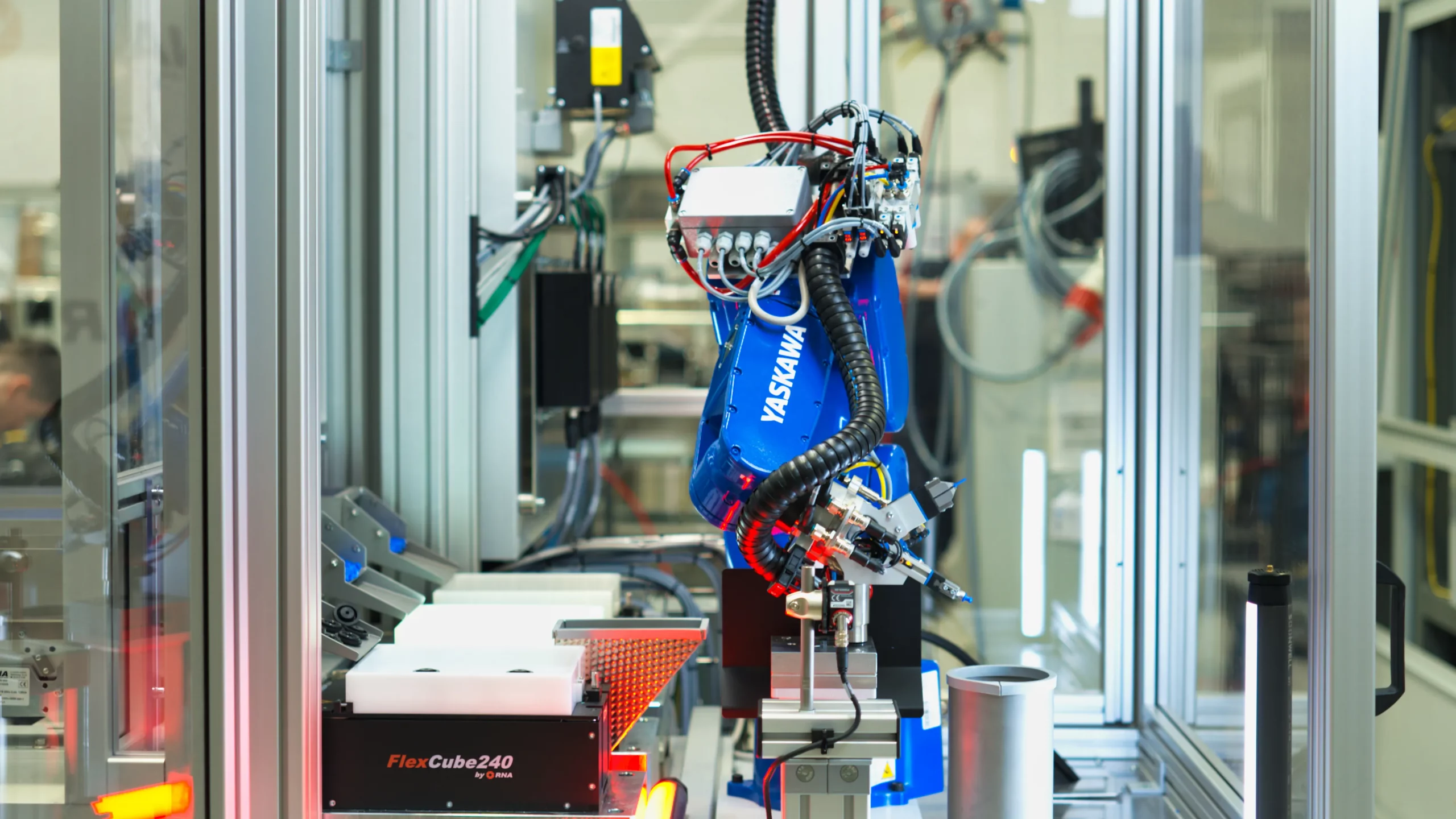
Automated cells and integrated production lines can contain several interacting hazards. A safety film can show where operators enter the process, how safeguarding works and what must happen before intervention or maintenance.
Clear labels, highlighted zones and simple diagrams can help viewers follow the relationship between sensors, robots, conveyors and controls. Examples of industrial automation video show how detailed machine actions can be placed within the context of the complete system.
The finished explanation should complement approved training and documentation rather than replace them. Video is strongest when it prepares people to understand a procedure and gives trainers a consistent visual reference.
Design content for the way it will be viewed
A full induction film may be shown in a training room, but shorter safety messages could appear on display screens, tablets, learning platforms or QR-linked pages beside equipment. Each setting creates different production requirements.
Subtitles help when sound cannot be used and improve access for people who prefer to read along. On-screen text should be large enough for the intended display. Translated voiceovers or captions may be needed for a multilingual workforce, and the original script should use direct language that localises cleanly.
Breaking a longer programme into clearly labelled chapters also makes updates easier. If one process changes, the relevant section can be revised without rebuilding every piece of safety content.
Use real people with careful preparation
Employees can bring authenticity to a safety film because they understand the environment and use the equipment. They should be briefed on the sequence, given time to rehearse and supported by the appropriate supervisor. Nobody should feel pressured to perform an unfamiliar task for the camera.
Presenters and contributors do not need to deliver long scripted speeches. Short introductions, demonstrations and simple explanations are often more credible. A voiceover can carry detailed information while employees show the behaviour being described.
Permissions and privacy also need attention, particularly when films will be shared beyond the site. Agreeing how and where the footage may be used protects both the company and the people involved.
Keep safety videos current
A safety film is only useful while it reflects present conditions. Machinery, layouts, signage, protective equipment and procedures can change. Every asset should therefore have an owner, an approval date and a planned review point.
Keeping scripts, project files and clean footage organised makes future changes more efficient. Modular films are especially helpful because an outdated section can be replaced without discarding material that remains accurate.
Feedback from trainers and viewers can guide those updates. Repeated questions may reveal that a sequence needs a clearer angle, an extra caption or a slower demonstration. This turns the content into a living part of the safety communication system.
Support a consistent safety culture
Industrial video production does more than transfer instructions. It can show that safe working is part of how the organisation plans, communicates and operates. When leaders, engineers and operators appear in a clear and accurate programme, the message feels connected to the real workplace.
Video should sit alongside competent instruction, supervision and current written procedures. Used in that role, it helps people arrive better prepared, recognise the environment and remember the actions required of them.
If you need to explain a site induction or industrial procedure on screen, contact Industreel to discuss a safe, practical production plan.