Research and development work often involves ideas, prototypes and test results that are difficult to explain outside the project team. Written reports provide essential detail, but they may not capture how a system operates, why a design changed or what happened during a significant trial. Industrial video production can document that work in a clear, structured and credible way.
A planned film can support funding reviews, internal knowledge sharing, partner updates and eventual product launches. It creates a visual record of progress while helping technical specialists communicate with audiences who may not share the same engineering background.
Define what the project needs to communicate
An R&D film should begin with a clear purpose. Some projects need to demonstrate a milestone to funders. Others need to share learning between departments, attract commercial partners or explain an emerging technology to potential customers.
Those objectives shape the story. A technical record may focus on methods, configurations and test conditions, while a stakeholder film will give more attention to the problem, the development journey and the potential application.
Agreeing the primary audience prevents the production from becoming either too dense or too general. Where several groups need different levels of detail, one filming programme can produce a main overview and a set of focused technical chapters.
Capture development before important stages disappear
Prototypes change quickly. Temporary rigs are dismantled, components are replaced and test environments are cleared once a phase is complete. Waiting until the end of a programme can mean losing the most useful evidence of how the work developed.
A milestone-based filming plan captures key stages as they occur. Early footage might show the initial problem and first prototype. Later visits can document refinements, integration, testing and the final demonstrator. Consistent camera positions make physical progress easier to see.
The schedule should be flexible enough to follow real development. Tests move, faults appear and promising results sometimes require another iteration. Close communication between the production team and project lead helps cameras arrive when there is something meaningful to record.
Make technical work understandable
R&D teams use specialist language because it is precise, but external viewers may need more context. A strong film does not remove the engineering; it organises it around a question the audience can understand.
The story can establish the existing challenge, show the proposed approach and then explain how testing evaluates it. Interviews, process footage and graphics each play a different role. The camera shows what physically happened, contributors explain why, and graphics clarify relationships that are hard to see.
Professional video production helps turn these elements into a coherent account without overstating results or simplifying the science beyond recognition.
Film tests with enough context
A dramatic close-up of a prototype may look impressive but reveal little about the trial. Useful test footage should show the setup, relevant instrumentation, operating sequence and result. Wide views establish the environment, while detailed shots reveal measurements, materials and component behaviour.
Where possible, record a clean explanation before the test begins. The project engineer can identify what is being evaluated, the expected outcome and any important limitations. A short contribution afterwards can place the result in context.
Not every test produces success, and that can still be valuable. R&D communication gains credibility when it shows an honest development process and explains how evidence informed the next decision.
Use graphics for invisible processes
Many innovations depend on forces, data, internal mechanisms or microscopic changes that a camera cannot capture directly. Diagrams and animation can reveal those processes while maintaining a connection to real footage.
A simple overlay may identify sensors or trace material flow. A 3D animation can show the inside of an enclosure, compare design iterations or demonstrate a proposed system that does not yet exist at full scale. Charts can present selected results when the data has been approved for the intended audience.
Graphics should use consistent terminology, units and colours. Technical reviewers need to check every representation so that visual clarity never comes at the cost of accuracy.
Explain automation as a complete system
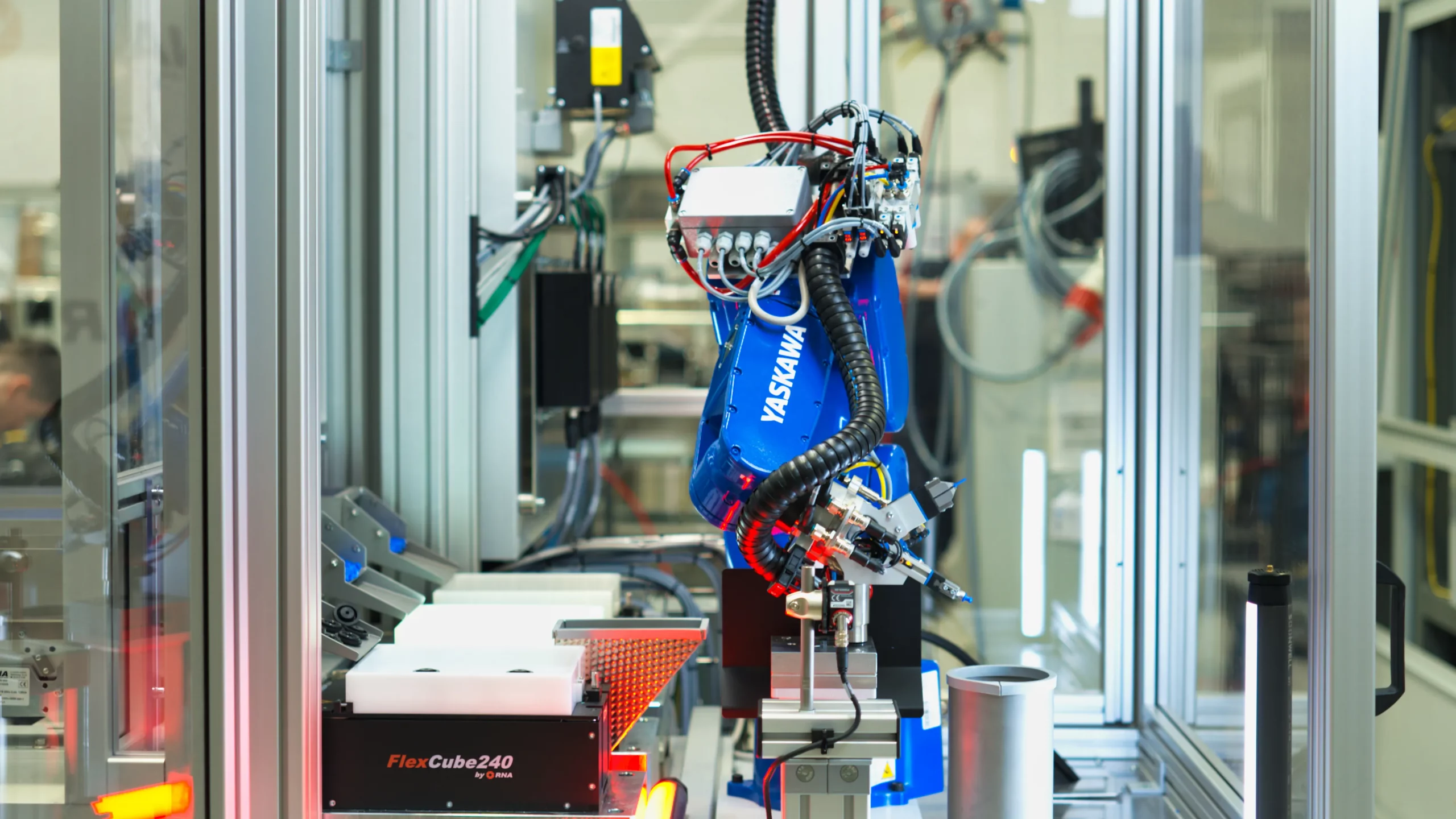
Automation development may combine mechanics, controls, software and human interaction. Showing only the fastest machine movement can hide the engineering that makes the system reliable.
Examples of industrial automation video demonstrate how wide operational views, detailed sequences and interface footage can establish the relationship between components. Animation can add signal flow, guarded areas or data exchange when those elements are not visible.
The film should make clear whether a sequence represents a prototype, a controlled test or a production-ready system. This distinction protects credibility and helps viewers interpret the evidence correctly.
Let researchers explain the decisions
The people doing the work provide essential context. Engineers, scientists and technicians can explain why a particular route was chosen, what a test revealed and which challenge remains to be solved.
Interviews work best when they focus on decisions rather than broad promotional statements. Contributors can prepare key points without memorising a script, helping their answers remain natural and precise.
Capturing voices throughout the project also preserves knowledge that may otherwise be lost when teams change. These recordings can support internal reviews and future training as well as public communication.
Protect intellectual property and confidential data
R&D filming requires careful control. Drawings, screens, customer materials and proprietary details may appear in the working environment. The production plan should identify restricted subjects, approved camera positions and the intended audience for each version.
Different edits may be needed for internal, partner and public use. A secure technical record can include detail that is removed from a launch film. Clear filenames, access permissions and approval stages reduce the risk of sensitive footage being shared incorrectly.
Everyone appearing on camera should understand how their contribution may be used. The same applies to partner facilities, jointly owned technology and externally funded programmes.
Create evidence for project reviews
Funders and senior stakeholders may need to assess progress without visiting the site. A concise milestone film can show equipment, experiments and outcomes while linking them to the agreed objectives.
The film should complement formal reporting rather than replace it. References to work packages, dates or performance measures can help viewers connect visual evidence with written documentation. A transcript also makes the content easier to review and reference.
Short updates recorded at planned intervals can later be combined into a complete development story, showing not only the final result but the disciplined process that produced it.
Build an asset library for future commercialisation
When an R&D project moves towards launch, early footage becomes valuable. It can show the origin of the idea, the challenges overcome and the depth of engineering behind the finished product.
Capturing clean process shots, prototype details and expert interviews creates material for presentations, exhibitions, recruitment and product marketing. Not every image will be suitable for public use immediately, so accurate labelling and permissions are important.
A modular archive allows the communications team to select approved content as the technology matures, without trying to reconstruct the development history later.
Give innovation a clear visual record
Industrial video production helps R&D teams make complex progress visible. It can preserve experimental evidence, explain technical decisions and connect the work to a wider commercial or social purpose.
The strongest projects plan filming alongside development rather than treating it as a final announcement. With technical oversight, careful access control and a clear audience, video becomes a useful part of the programme itself.
If you need to document a prototype, test programme or emerging industrial technology, contact Industreel to discuss a production plan built around your development milestones.